
Reconstitution Solutions For Research Purposes
Categories
- Amino Acids and Lipotropic Compounds
- Antioxidants and Detox Agents
- Cognitive and Longevity Peptides
- Growth and Performance Peptides
- Hormone Balance Research Peptides
- Metabolic Research Peptides
- Reconstitution Solutions For Research Purposes
- Recovery and Repair Peptides
- SHOP ALL PRODUCTS
- Skin and Aesthetic Peptides
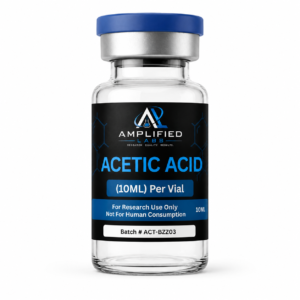
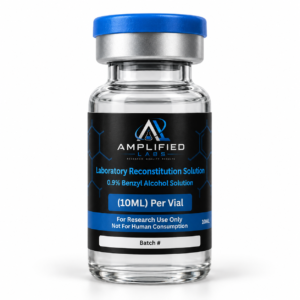
Amplified Labs offers two aqueous solutions for laboratory research, each labelled 10 mL per vial. Bacteriostatic Water (BAC) 10 mL contains 0.9% benzyl alcohol as a preservative, for protocols that call for a preserved diluent. Acetic Acid 0.6% solution contains 0.6% acetic acid, for protocols that call for mild acidification. Choose the composition your protocol specifies. A side-by-side comparison follows the products.
For offer terms while browsing bacteriostatic water or acetic acid solution, see the Black Friday and Cyber Monday offer.
Showing all 2 results
-
Reconstitution Solutions For Research Purposes
Acetic Acid 0.6% solution
$15.50 Purchase & earn 16 Researcher points!Add to cart -
Reconstitution Solutions For Research Purposes
Bacteriostatic Water (BAC) 10mL
$10.75 Purchase & earn 11 Researcher points!Add to cart
Compare the two formulations
| Solution | Stated composition | Labelled volume | Stated laboratory role |
|---|---|---|---|
| Bacteriostatic Water (BAC) 10 mL | Water with 0.9% benzyl alcohol (listed as 9 mg/mL) | 10 mL per vial | Preserved aqueous diluent |
| Acetic Acid 0.6% solution | Water with 0.6% acetic acid (listed as 6 mg/mL) | 10 mL per vial | Mild acidification and pH adjustment; listed as non-sterile |
The two solutions serve different purposes. Benzyl alcohol is a preservative, so BAC water suits protocols that specify a preserved diluent. The acetic acid listing states a role in mild acidification and pH adjustment, so the 0.6% solution suits protocols that specify a mildly acidic solution. Both are clear, colorless liquids with a stated storage temperature of 20–25°C. Both are sold for laboratory research use only, and the BAC listing states that it is not for injection.
Choosing a solution and calculating concentration
The right solvent depends on the material. A peptide’s sequence, charge and other properties affect how well it dissolves, and its stability depends on sequence and experimental conditions. For background, see this peptide solubility and stability reference. Use the documentation for your specific material and your laboratory protocol to identify the composition required.
Once your protocol sets the labelled mass and final volume, these resources can help:
- Reconstitution Calculator: converts labelled mass and final solution volume into concentration in mg/mL and mcg/mL.
- COA Finder: search available original reports by product, report number or full lot. Each report shows the sample, lot and tests it covers.
Reconstitution Solutions FAQs
How does bacteriostatic water differ from sterile water?
The key difference is preservative content. Our Bacteriostatic Water (BAC) 10 mL contains 0.9% benzyl alcohol as a preservative. Preservative-free sterile water contains no bacteriostat or other antimicrobial agent. A preservative and sterility are separate attributes, so one does not imply the other. This category does not include a preservative-free sterile water product. The two options here are BAC water and 0.6% acetic acid solution.
What is the difference between 0.6% acetic acid solution and BAC water?
Each is water with a different additive serving a different role. BAC water contains 0.9% benzyl alcohol (listed as 9 mg/mL), which acts as a preservative. The acetic acid solution contains 0.6% acetic acid (listed as 6 mg/mL) for mild acidification or pH adjustment, and it is listed as non-sterile. Both are labelled 10 mL per vial. Choose based on whether your protocol calls for a preserved diluent or an acidified one.
Can one reconstitution solution be assumed suitable for every research peptide?
No. A peptide’s solubility depends on its sequence, charge and other properties, and its stability depends on sequence and experimental conditions. Check the documentation for your specific material and your laboratory protocol, then choose the solution whose stated composition matches what they call for.
What do mL, percent concentration and mg/mL mean on the solution labels?
The 10 mL on both vial labels is the nominal volume per vial. The percentage gives the concentration of each solution’s additive: 0.9% benzyl alcohol in BAC water and 0.6% acetic acid in the acid solution. The listings also state these additives in mg/mL: 9 mg/mL benzyl alcohol for BAC water and 6 mg/mL acetic acid for the acid solution.
Where can I calculate concentration from a labelled mass and final solution volume?
Use our Reconstitution Calculator. It divides the labelled mass in mg by the final solution volume in mL to give concentration in mg/mL, then multiplies by 1,000 to give mcg/mL. It also offers optional aliquot-volume arithmetic, and the page shows the formula with worked examples. The calculator works only with the values you enter. It does not choose a solvent, volume or amount.